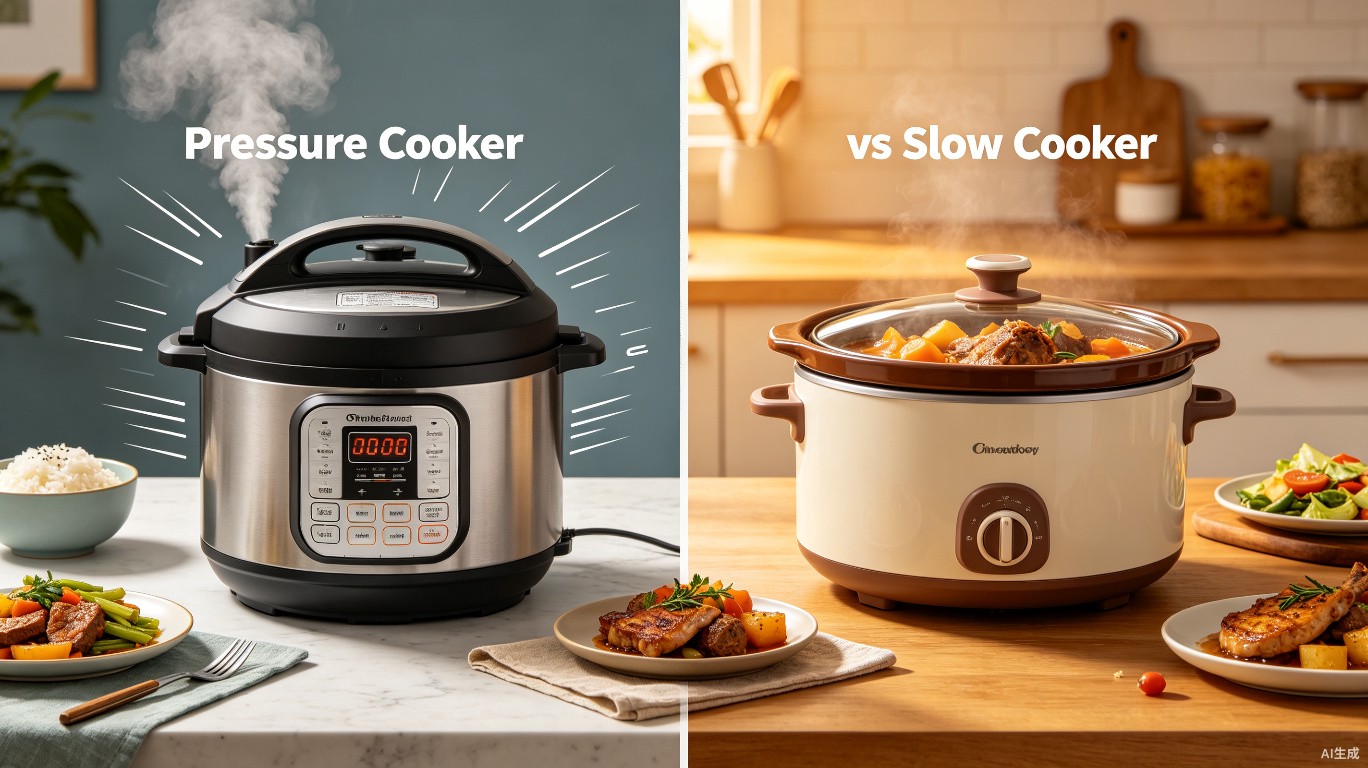
It is one of the most common questions in the modern kitchen: should you buy a pressure cooker or a slow cooker? Both appliances promise to make your life easier and your meals more delicious, but they do so in fundamentally different ways. A pressure cooker uses high-pressure steam to cook food in a fraction of the time, while a slow cooker uses low, gentle heat over many hours to develop deep, complex flavors. The choice between them is not just about cooking speed — it is about cooking philosophy, lifestyle, and the kinds of meals you want to create.
In this comprehensive comparison, we examine every major dimension of the pressure cooker versus slow cooker debate, from cooking speed and energy efficiency to flavor development, texture, safety, and cost. By the end of this guide, you will have a clear understanding of which appliance (or combination of appliances) best suits your needs, cooking style, and schedule.
Speed: Hours vs Minutes
The most dramatic difference between a pressure cooker and a slow cooker is cooking time. This is the single most important factor for many buyers, and it is worth examining in detail.
A pressure cooker can complete dishes in minutes that would take hours in a slow cooker. Here are some typical comparisons:
- Beef stew: Pressure cooker: 35-45 minutes. Slow cooker: 7-8 hours on low.
- Pulled pork: Pressure cooker: 60-75 minutes. Slow cooker: 8-10 hours on low.
- Chicken broth: Pressure cooker: 45-60 minutes. Slow cooker: 12-24 hours.
- Dried beans (no soak): Pressure cooker: 25-40 minutes. Slow cooker: 6-8 hours on high.
- Risotto: Pressure cooker: 8-10 minutes. Slow cooker: 3-4 hours on high.
- Cheesecake: Pressure cooker: 30-35 minutes. Slow cooker: 2-3 hours on low (water bath required).
On average, a pressure cooker reduces cooking time by 70 to 90 percent compared to a slow cooker. For weeknight dinners when you are short on time, the pressure cooker is the undisputed champion. You can start a meal at 5:30 PM and have it on the table by 6:15 PM — something that is simply impossible with a slow cooker unless you started it hours earlier.
A slow cooker, on the other hand, is designed for the long game. You load it up in the morning before work, set it to low, and come home eight to ten hours later to a meal that has been gently cooking all day. The extended cooking time allows flavors to meld and develop in ways that pressure cooking cannot replicate, particularly for dishes that benefit from prolonged exposure to gentle heat, such as braised short ribs, French onion soup, or traditional pot roast.
Flavor and Texture Differences
Speed is not the only difference between these two cooking methods. The way each appliance applies heat has a profound impact on the flavor and texture of the finished dish.
Pressure Cooker Flavor Profile
Pressure cooking excels at extracting and concentrating flavors quickly. The sealed environment traps volatile aromatic compounds that would normally evaporate during long cooking, resulting in intensely flavored broths, sauces, and braises. The high temperature and pressure also accelerate the Maillard reaction (the chemical process that creates browning and complex flavors) when you sear meat before pressure cooking, though the sealed environment means that sauces do not reduce and thicken the way they do during slow cooking.
The texture of pressure-cooked food tends to be more moist and tender, as the pressurized environment forces liquid into the food. This is ideal for tough cuts of meat, dried legumes, and fibrous vegetables. However, some cooks note that pressure-cooked dishes can lack the layered depth of flavor that develops over hours of slow cooking, particularly in complex dishes like curries, stews, and braises where individual spices and ingredients have time to meld gradually.
Slow Cooker Flavor Profile
Slow cooking is all about patience and depth. The extended cooking time at low temperatures allows flavors to develop gradually and harmoniously. Spices mellow and blend, collagen in meat breaks down into gelatin over many hours (producing that luxurious, silky mouthfeel), and sauces reduce and concentrate naturally as moisture slowly evaporates through the vented lid.
The texture of slow-cooked food is characteristically fall-apart tender, with a depth of flavor that is difficult to achieve through faster cooking methods. Dishes like coq au vin, beef bourguignon, and traditional chili benefit enormously from the slow cooker's gentle, prolonged heat. The low temperature also means that it is very difficult to overcook food in a slow cooker — a dish that is done at the 6-hour mark will still be excellent at 8 or even 10 hours, giving you flexibility in your timing.
However, slow cooking is not without its drawbacks. Delicate vegetables can become mushy if added too early, herbs lose their bright flavor during extended cooking (requiring the addition of fresh herbs at the end), and the gentle heat means that food does not brown or caramelize during the cooking process. Many slow cooker recipes recommend browning meat in a separate pan before adding it to the slow cooker to compensate for this limitation.
Energy Efficiency
When it comes to energy consumption, the pressure cooker has a clear advantage, though the full picture is more nuanced than it might appear.
A pressure cooker uses significantly less energy per cooking session because it cooks food much faster. An electric pressure cooker typically uses between 700 and 1,000 watts of power, and a cooking session lasting 30-60 minutes consumes roughly 0.35 to 1.0 kWh of electricity. Even a stovetop pressure cooker on a gas burner uses less total energy than an oven or slow cooker running for many hours, because the cooking time is so much shorter.
A slow cooker uses very low wattage (typically 75-250 watts on the low setting), but it runs for 8-10 hours or more. A typical slow cooking session on low consumes approximately 1.0 to 2.0 kWh of electricity. While the per-hour energy consumption is lower than a pressure cooker, the extended runtime means the total energy per session is often higher.
Over the course of a year, if you cook 3-4 meals per week, the energy savings from using a pressure cooker instead of a slow cooker can amount to 100-200 kWh, translating to roughly $15-$30 in electricity costs depending on your local rates. While this is not a dramatic difference for most households, it does add up over time and contributes to a smaller environmental footprint.
Best Use Cases for Each Appliance
Rather than thinking of pressure cookers and slow cookers as competitors, it is more useful to understand the specific scenarios where each excels.
When to Use a Pressure Cooker
- Weeknight dinners: When you need a meal on the table in under an hour, the pressure cooker is unmatched. Soups, stews, curries, pasta sauces, and braised meats can all be prepared quickly.
- Cooking dried beans and grains: Pressure cooking eliminates the need for overnight soaking and cooks dried beans, lentils, chickpeas, and whole grains in 20-40 minutes.
- Making stocks and broths: A rich, flavorful bone broth that would take 12-24 hours in a slow cooker can be made in 60-90 minutes in a pressure cooker.
- Steaming vegetables: Pressure steaming cooks vegetables in 2-4 minutes while preserving color, texture, and nutrients better than almost any other method.
- Meal prep and batch cooking: The speed of pressure cooking makes it ideal for preparing large batches of food for the week ahead.
- High-altitude cooking: At high altitudes, water boils at lower temperatures, making conventional cooking slower. Pressure cookers compensate by creating their own high-pressure environment.
When to Use a Slow Cooker
- All-day cooking: When you want to prepare a meal in the morning and come home to it ready and waiting, the slow cooker is perfect. Load it up before work and forget about it until dinner.
- Complex braises and stews: Dishes like beef bourguignon, osso buco, and traditional pot roast develop deeper, more nuanced flavors during 8+ hours of gentle cooking.
- Entertaining and potlucks: Slow cookers keep food warm for hours without overcooking, making them ideal for serving dips, soups, chili, and pulled meats at gatherings.
- Yogurt and fermented foods: The precise low-temperature control of a slow cooker makes it excellent for making homemade yogurt, kefir, and other fermented foods.
- Cooking while away: If you plan to be out of the house for 8-12 hours, a slow cooker allows you to have a meal ready when you return without any additional effort.
- Tenderizing very tough cuts: While pressure cookers can tenderize tough meat quickly, the texture achieved through 10+ hours of slow cooking is uniquely silky and fall-apart in a way that some dishes (like traditional carnitas or certain braises) truly benefit from.
Can You Replace One with the Other?
This is a question we hear frequently: can a pressure cooker do everything a slow cooker does, or vice versa? The answer depends on how you define "replace."
Many electric pressure cookers and multi-cookers include a slow cooking function. Models like the Instant Pot Duo and Ninja Foodi have dedicated slow cooking settings that allow you to cook at low or high temperatures for extended periods, mimicking the behavior of a traditional slow cooker. However, there are important differences to be aware of:
- Heat distribution: Traditional slow cookers heat from the sides and bottom with gentle, even warmth. Many electric pressure cookers heat primarily from the bottom, which can result in slightly different cooking behavior when used as a slow cooker. Food near the bottom may cook slightly faster than food near the top.
- Lid design: Slow cooker lids are vented, allowing moisture to evaporate slowly and sauces to reduce and concentrate over time. Pressure cooker lids are sealed, which means moisture does not evaporate during slow cooking. This can result in more liquid in the finished dish compared to a traditional slow cooker. You may need to reduce the amount of liquid in recipes or remove the lid for the last 30-60 minutes to allow reduction.
- Capacity and shape: Slow cookers are typically oval-shaped and available in very large sizes (up to 8+ quarts of usable capacity), making them ideal for large roasts and entertaining. Electric pressure cookers are round and have more limited capacity.
- Keep-warm performance: Slow cookers excel at keeping food warm for extended periods without overcooking. While pressure cookers have a keep-warm function, it is not quite as gentle or long-lasting as a slow cooker's warming mode.
Can a slow cooker replace a pressure cooker? No. A slow cooker cannot replicate the high-pressure, high-temperature cooking that makes pressure cookers so fast. You cannot pressure cook beans in 30 minutes, make broth in an hour, or steam vegetables in 3 minutes with a slow cooker. The slow cooker simply cannot generate the pressure needed for these tasks.
Our recommendation: If you can only buy one appliance and you lead a busy lifestyle, choose an electric pressure cooker or multi-cooker with a slow cooking function. You will get 90 percent of the slow cooker experience along with all the speed and versatility of pressure cooking. If you have the space and budget for both, having a dedicated slow cooker and a dedicated pressure cooker gives you the best of both worlds.
Safety Comparison
Both modern pressure cookers and slow cookers are remarkably safe appliances, but they have different safety considerations.
Pressure cooker safety: Modern pressure cookers incorporate multiple redundant safety systems including locking lids, overpressure release valves, anti-blockage shields, and temperature sensors. The risk of injury is extremely low when the appliance is used according to the manufacturer's instructions. The primary safety concern is steam burns during pressure release, which can be avoided by following proper release techniques and keeping your face and hands away from the steam vent.
Slow cooker safety: Slow cookers are among the safest kitchen appliances available. They operate at low temperatures, have no pressure, and most models feature cool-touch exteriors. The main safety considerations are ensuring the appliance is placed on a heat-resistant surface, keeping the cord away from the edge of the counter, and following food safety guidelines for proper thawing and reheating. The USDA recommends that slow cooker recipes include at least 1 cup of liquid and that frozen ingredients be thawed before adding to the slow cooker to ensure safe cooking temperatures are reached promptly.
Cost Comparison
Both pressure cookers and slow cookers are available at a wide range of price points, making it easy to find an option that fits your budget.
- Budget slow cookers: Basic models from Crock-Pot, Hamilton Beach, and Black+Decker start at $20-$35 for 4-quart models and $30-$50 for 6-7 quart models.
- Premium slow cookers: Models with programmable controls, oval inserts, and locking lids for transport (like the Crock-Pot Smart-Pot or All-Clad 7-Quart) range from $60-$150.
- Budget pressure cookers: Basic electric models from COSORI and Midea start at $50-$70. Stovetop models from Presto start at $40-$60.
- Premium pressure cookers: High-end electric models from Instant Pot and Ninja range from $80-$150. Premium stovetop models from Fissler and Kuhn Rikon range from $100-$200.
- Multi-cookers: Models that combine pressure cooking and slow cooking (like the Ninja Foodi) range from $130-$300.
If budget is your primary concern and you only need one appliance, a basic slow cooker offers the lowest entry price at around $25-$35. However, if you value versatility and speed, a budget electric pressure cooker at $50-$70 delivers far more functionality per dollar.
Final Verdict: Which Should You Buy?
The choice between a pressure cooker and a slow cooker ultimately comes down to your lifestyle, cooking habits, and priorities:
- Buy a pressure cooker if: You want fast meals on busy weeknights, you enjoy cooking a wide variety of foods (from beans to broths to cheesecake), you value energy efficiency, and you want a versatile appliance that can handle most cooking tasks.
- Buy a slow cooker if: You prefer the "set it and forget it" approach, you love the deep flavors of long-braised dishes, you frequently cook for crowds or entertain, and you want the simplest, most affordable appliance possible.
- Buy both (or a multi-cooker) if: You want maximum flexibility, you enjoy both quick weeknight meals and slow-cooked weekend feasts, and you have the kitchen space and budget for both appliances.
Ready to Find Your Perfect Cooker?
Whether you choose a pressure cooker, a slow cooker, or a versatile multi-cooker that does both, we have tested and ranked the best options on the market to help you choose with confidence.
See Our Best Pressure Cooker Reviews →