Table of Contents
It is one of the most common questions in the kitchen appliance world: what is the difference between a food processor and a blender, and do you need both? At first glance, these two countertop machines may seem interchangeable. Both have motors, both have blades, and both can break down food into smaller pieces. But scratch the surface, and you will discover that food processors and blenders are engineered for fundamentally different purposes, with different bowl shapes, blade designs, and operating principles that make each one uniquely suited to certain tasks.
In this detailed comparison, we break down every important difference between food processors and blenders. We explain when to reach for each one, whether you can substitute one for the other, and help you decide whether investing in both makes sense for your kitchen. By the end, you will have a clear answer to the food processor vs. blender debate.
Key Differences Between Food Processors and Blenders
While food processors and blenders share some similarities, their design differences are significant and purposeful.
Bowl Shape and Size
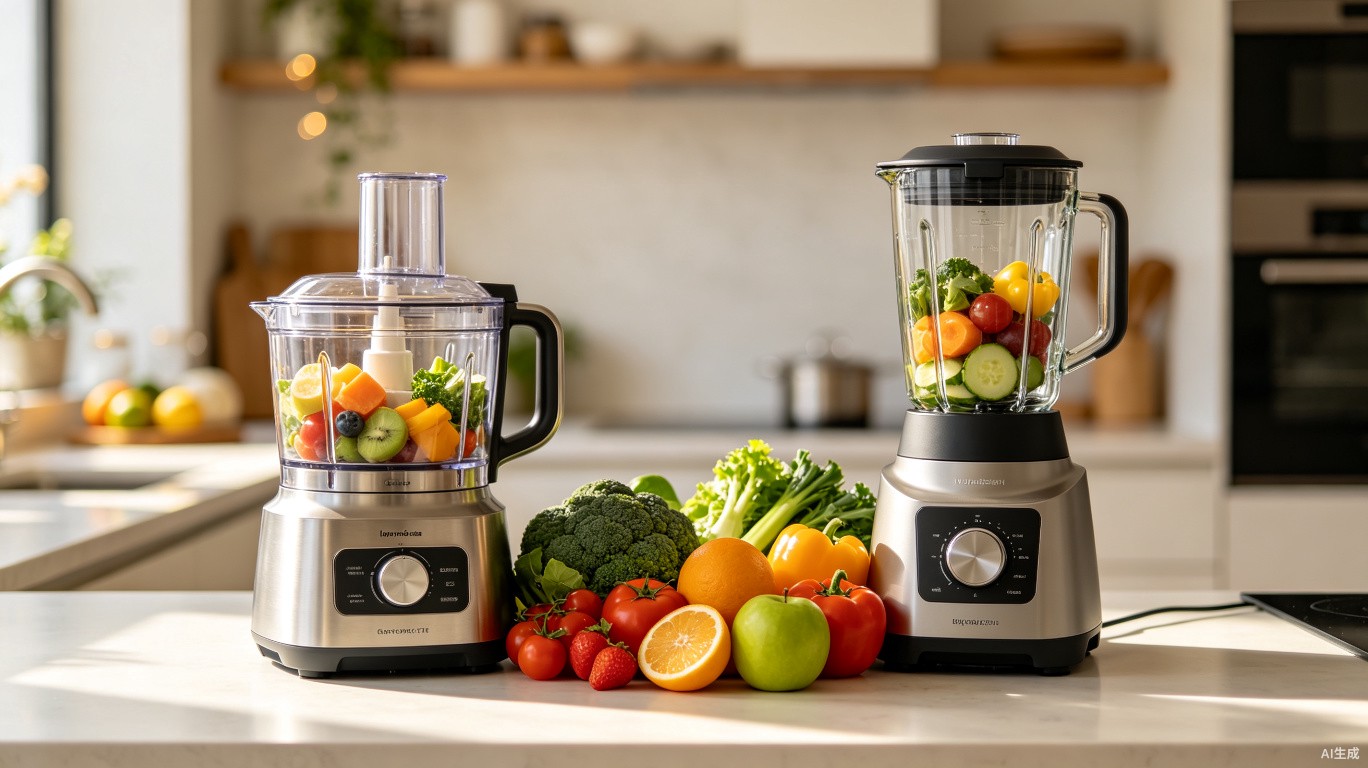
The most visible difference is the container. A food processor uses a wide, shallow bowl (typically 9-14 cups) that spreads food out in a thin layer across the bottom. This design is ideal for processing solid foods evenly, as the blades can reach all the food without it piling up too high. A blender uses a tall, narrow pitcher (typically 32-64 ounces) that creates a vortex when the blades spin, pulling ingredients downward into the blade path. This design is optimized for liquids and semi-liquids.
Blade Design
Food processors use interchangeable blades and discs mounted on a central shaft. The standard S-blade sits near the bottom of the bowl and is designed for chopping and pureeing solid foods. Additional discs handle slicing, shredding, and other tasks. Blenders use fixed, angled blades at the base of the pitcher, typically a four- or six-point star pattern designed to create a powerful vortex that circulates liquid ingredients.
Motor and Speed
Food processors typically operate at lower speeds with higher torque, which is ideal for pushing through solid foods like cheese, dough, and raw vegetables. Blenders operate at higher speeds to create the vortex necessary for liquefying ingredients. A blender's motor may be more powerful in raw wattage, but that does not necessarily make it better at food processor tasks.
Feed Mechanism
Food processors feature a feed tube in the lid that allows you to add ingredients while the machine is running. This is essential for tasks like emulsifying oil into mayonnaise or pushing vegetables through a slicing disc. Blenders require you to remove a plug in the lid to add ingredients, and the tall pitcher design means you cannot easily process small quantities of solid food.
| Feature | Food Processor | Blender |
|---|---|---|
| Container Shape | Wide and shallow | Tall and narrow |
| Blade Type | Interchangeable blades and discs | Fixed angled blades at base |
| Primary Use | Solid food preparation | Liquid blending and crushing |
| Best Texture Result | Controlled chunks to smooth paste | Completely smooth liquids |
| Ice Crushing | Not recommended | Excellent |
| Slicing/Shredding | Yes, with disc attachments | No |
| Dough Kneading | Yes, with dough blade | No |
| Smoothie Making | Poor (too thick, uneven) | Excellent |
| Hot Liquid Processing | Not recommended | Yes (ventilated lid) |
| Typical Price Range | $40-$400+ | $30-$500+ |
When to Use a Food Processor
A food processor is the right tool for any task that involves solid foods and requires controlled texture. Here are the scenarios where a food processor shines:
- Chopping vegetables: Onions, peppers, celery, carrots, and herbs are all processed quickly and uniformly in a food processor. The wide bowl ensures even chopping without turning everything into mush.
- Making dips and spreads: Hummus, baba ganoush, bean dips, and tapenades all benefit from the food processor's ability to blend solid ingredients into a smooth or chunky consistency while maintaining body and texture.
- Slicing and shredding: With the right disc attachment, a food processor can slice cucumbers, shred cabbage for coleslaw, grate cheese, or shred potatoes for latkes in seconds.
- Making pastry and dough: Pie crust, pizza dough, and bread dough can all be made in a food processor. The fast blade action cuts fat into flour for flaky pastry and develops gluten for bread in a fraction of the time it takes by hand.
- Making nut butters: Processing roasted nuts in a food processor eventually releases their oils and creates smooth or chunky nut butter. This task requires patience and a powerful motor, but the wide bowl is ideal for the process.
- Making pesto and herb sauces: The food processor quickly reduces basil, pine nuts, garlic, cheese, and oil into a smooth pesto. The pulse function gives you control over the final texture.
When to Use a Blender
A blender excels at tasks involving liquids and frozen ingredients. Here is when you should reach for the blender:
- Smoothies and protein shakes: The tall pitcher and vortex action of a blender create perfectly smooth, drinkable beverages. A food processor cannot achieve the same silky consistency with liquid-heavy mixtures.
- Crushing ice: Blenders are specifically designed to crush ice for frozen drinks, smoothie bowls, and cocktails. A food processor's blade design and bowl shape make it ineffective for this task and may even damage the machine.
- Pureeing soups: While a food processor can puree thick soups, a blender creates a smoother, more velvety texture, especially for liquid-heavy soups. Many blenders can handle hot liquids (with the vent plug removed), while food processors should not be used with hot contents.
- Making smooth sauces: Hollandaise, bearnaise, and other emulsified sauces benefit from the blender's high-speed vortex, which creates a stable, silky emulsion.
- Frozen cocktails and desserts: Margaritas, pina coladas, frozen yogurt, and sorbet all require the ice-crushing and frozen-fruit-blending capabilities that only a blender can provide.
- Grinding coffee or spices (in a pinch): While a dedicated grinder is better, a blender can grind small quantities of coffee beans or whole spices in a pinch.
Can You Substitute One for the Other?
In some cases, yes, but with significant compromises. Here is a realistic look at how well each appliance can fill in for the other:
Using a Blender Instead of a Food Processor
A blender can handle some food processor tasks, but the results are often inferior. You can puree soft foods like cooked vegetables for soup or make salsa in a blender, but the tall pitcher means you need to add liquid to get the blades to catch the food, which dilutes your recipe. Chopping onions in a blender tends to create an uneven mess with some pieces pulverized and others barely touched. You cannot slice or shred with a blender, and kneading dough is impossible. The blender simply is not designed for the controlled processing of solid foods.
Using a Food Processor Instead of a Blender
A food processor can puree soft, wet foods, and it can make smooth sauces if you are patient. However, it cannot crush ice effectively, and the wide, shallow bowl does not create the vortex needed to blend frozen fruit into a smooth smoothie. You will end up with a chunky, uneven result that is more like a thick paste than a drinkable beverage. For hot liquids, the food processor's wide bowl creates steam pressure that can blow the lid off, making it potentially dangerous.
Bottom line: in a pinch, you can use one appliance for some of the other's tasks, but neither is a true substitute. If your budget allows, having both gives you the best results for the widest range of kitchen tasks.
Which Is Better for Specific Tasks?
To make this comparison as practical as possible, here is a task-by-task breakdown of which appliance performs better:
| Task | Winner | Why |
|---|---|---|
| Chopping onions | Food Processor | Even, controlled chopping without excess liquid |
| Making smoothies | Blender | Vortex action creates smooth, drinkable consistency |
| Making hummus | Food Processor | Wide bowl handles thick, solid mixtures better |
| Crushing ice | Blender | Designed for ice; food processor may be damaged |
| Slicing vegetables | Food Processor | Only a food processor has slicing disc attachments |
| Making soup puree | Blender | Smoother texture; can handle hot liquids safely |
| Kneading dough | Food Processor | Only a food processor can knead bread or pastry dough |
| Making nut butter | Food Processor | Wide bowl allows nuts to circulate and release oils |
| Making frozen drinks | Blender | Ice crushing and frozen fruit blending are blender strengths |
| Making pesto | Food Processor | Controlled chopping and emulsification of thick sauce |
| Shredding cheese | Food Processor | Shredding disc produces uniform results in seconds |
| Making mayo | Tie | Both work; food processor gives more control, blender is faster |
Do You Need Both?
The answer depends on your cooking habits, kitchen space, and budget. Here is our guidance:
You Probably Need Both If:
- You cook regularly and prepare a wide variety of recipes
- You make smoothies or frozen drinks frequently
- You do a lot of vegetable prep (chopping, slicing, shredding)
- You bake bread or make pastry
- You enjoy making homemade dips, spreads, and sauces
A Food Processor Alone Is Enough If:
- You primarily cook savory meals and do a lot of vegetable prep
- You rarely make smoothies or frozen drinks
- You already own an immersion blender for soups and sauces
- You bake bread or make pastry regularly
A Blender Alone Is Enough If:
- Your primary use is smoothies, protein shakes, and frozen drinks
- You do not cook much and mainly need an appliance for beverages
- You are on a tight budget and can only afford one appliance
- You are comfortable chopping vegetables by hand
Ready to Find the Perfect Food Processor?
If you have decided a food processor is the right choice for your kitchen, check out our tested and ranked reviews of the best models available in 2026.
See Our Top Picks for 2026Frequently Asked Questions
Can I make smoothies in a food processor?
Technically yes, but the results will not be as smooth as a blender. A food processor's wide, shallow bowl does not create the vortex needed to fully liquefy frozen fruit and ice. You will get a thicker, slightly chunkier result that is more like a smoothie bowl than a drinkable smoothie. If smoothies are your priority, invest in a blender.
Can I crush ice in a food processor?
Most food processors are not designed to crush ice and doing so may damage the blades or motor. The S-blade and bowl geometry are optimized for solid foods, not frozen cubes. Some high-end food processors claim ice-crushing capability, but for consistent results and to protect your investment, use a blender for ice-related tasks.
Is a food processor worth it if I already have a blender?
Absolutely. A food processor and a blender serve different purposes and complement each other well. If you already have a blender for smoothies and soups, a food processor opens up an entirely new range of capabilities: chopping, slicing, shredding, dough kneading, and making dips and spreads. Together, they cover the vast majority of kitchen prep tasks.
Which is easier to clean, a food processor or a blender?
Both are relatively easy to clean, but blenders have a slight edge. Many blender pitchers are dishwasher safe, and you can often clean them by blending warm soapy water. Food processors have more parts (bowl, lid, blade, pusher, and sometimes multiple discs), which means more pieces to wash. However, most food processor parts are also dishwasher safe. The S-blade requires careful hand washing to avoid cuts.
What about combo units that blend and process?
Some brands offer combination units that include both a blender pitcher and a food processor bowl on the same motor base. These can be a good space-saving option if you have limited counter storage. However, combo units often involve compromises: the food processor bowl may be smaller than a dedicated model, and the blender pitcher may not be as well-designed as a standalone blender. If you have the space and budget, separate dedicated appliances generally deliver better results.
Which should I buy first, a food processor or a blender?
Consider what you cook most often. If you make smoothies daily but rarely chop vegetables in bulk, buy a blender first. If you cook savory meals regularly and want to reduce prep time, start with a food processor. For most home cooks who prepare a variety of meals, a food processor offers more unique capabilities that cannot be easily replicated with other tools, making it the better first purchase.